
Charitable sweepstakes are nonprofit fundraising games of chance that let you enter for free while supporting a cause and competing for real prizes. Unlike a lottery or raffle, they require a no-purchase entry option by law, which makes them accessible to everyone. Organizations like Hopeforwardfoundation use this model to raise funds for emergency housing assistance while offering participants a chance at life-changing prizes, including a $250,000 grand cash award. Understanding how these programs work helps you give confidently, protect yourself from scams, and make the most of every entry.
How charitable sweepstakes work: entry methods and donation process
Charitable sweepstakes operate on a simple principle. You can enter by donating or by requesting a free entry, and both methods carry equal legal weight. The no-purchase entry requirement is not optional for nonprofits. It is the legal line that separates a sweepstakes from an illegal lottery.
Most campaigns offer two clear paths to enter:
- Free entry: Submit an online form or mail a written request to the nonprofit. No payment is required, and your entry carries the same odds as a paid one.
- Donation-based entry: Give at a set tier and receive entries in return. The Innocence Project, for example, uses donation tiers where $15 equals 1 entry and $250 equals 300 entries. Recurring donors often receive additional multipliers on top of their base entries.
Entry multipliers reward larger gifts with exponentially better odds. That structure encourages donors to give more while keeping participation open to everyone.
Campaign timelines are clearly defined. The 2026 Driven By Hope sweepstakes, run by the American Cancer Society, ran from April 17 to May 18 with a live drawing on May 20 via Zoom. That kind of public, streamed drawing is now standard practice for transparent nonprofits.
Pro Tip: Keep your donation receipt. The Innocence Project sends email receipts for tax purposes immediately after you give. Store that receipt with your tax documents before the filing deadline.

What is the legal difference between a sweepstakes and a raffle?
The legal distinction between a sweepstakes and a raffle comes down to one word: purchase. Raffles require you to buy a ticket to enter. That purchase requirement can trigger state gambling laws, which means nonprofits running raffles often need special licenses and face strict geographic restrictions.
Sweepstakes avoid that problem entirely. Charities choose sweepstakes to bypass the complex licensing and regulatory restrictions that come with raffles. The free entry alternative is not a loophole. It is the legal mechanism that keeps the program compliant in most U.S. states.
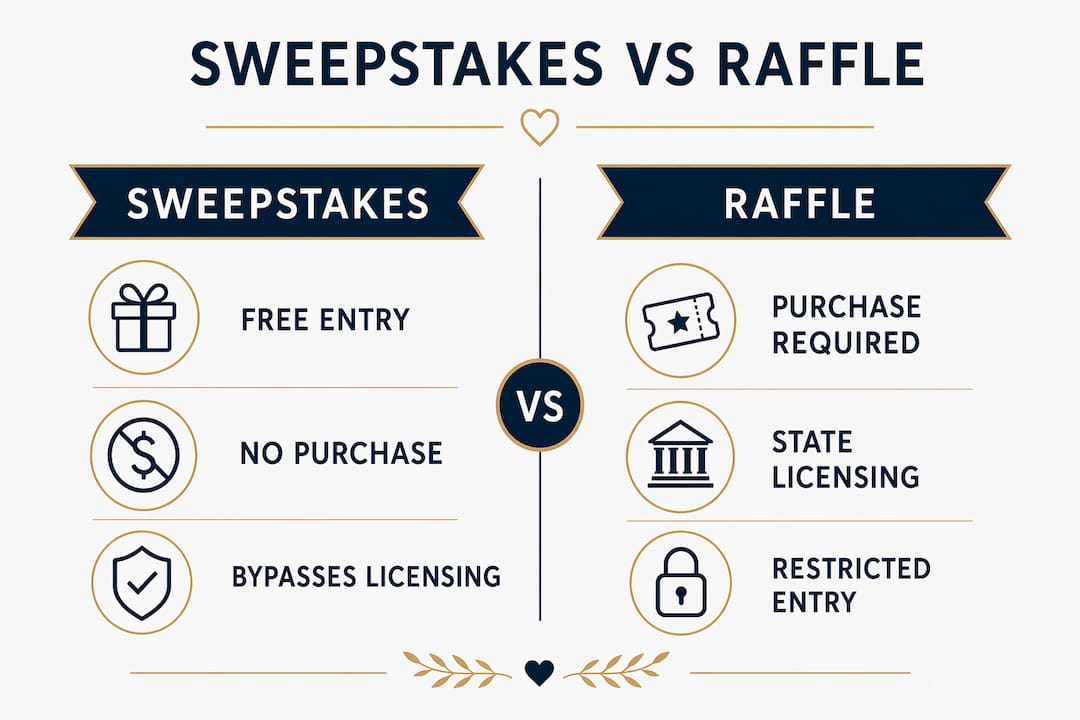
| Feature | Charitable sweepstakes | Charitable raffle |
|---|---|---|
| Purchase required | No | Yes |
| Free entry option | Required by law | Not applicable |
| Gambling law risk | Low, when compliant | Higher, varies by state |
| Online fundraising | Widely permitted | Often restricted |
| Licensing requirements | Minimal in most states | Frequently required |
Without a free entry alternative, a charity risks being classified as running an illegal lottery. That classification can result in fines, legal action, and damage to the nonprofit's reputation. Reputable organizations publish their official rules clearly and make the free entry process easy to find.
Proper sweepstakes management also means the free entry option carries the same rights as a paid entry. A nonprofit cannot quietly bury the free entry instructions in fine print and then weight drawings toward donors. Both entry types must receive equal treatment under the rules.
What should you expect as a participant: prizes, taxes, and winning
Prizes in charity sweepstakes for cash range widely. Common awards include:
- Cash prizes: Grand prizes from $10,000 to $250,000 are not unusual for well-funded campaigns.
- Experiences: Concert tickets, sports events, and celebrity meet-and-greets appear frequently.
- Travel packages: Vacations, hotel stays, and airfare bundles are popular mid-tier prizes.
- Merchandise: Electronics, gift cards, and branded goods round out most prize structures.
Winning feels exciting, but the tax side requires preparation. The IRS requires winners of prizes over $600 to report those winnings as taxable income. That rule applies regardless of whether you donated to enter or used the free entry option.
Prize values above $600 are reported to the IRS by the nonprofit, and you will receive a 1099 form. You bear the full tax obligation on that amount. A $250,000 cash prize, for instance, could push you into a higher federal tax bracket for that year.
Pro Tip: If you win a large prize, consult a tax professional before spending any of it. Set aside at least 25–30% of the prize value to cover federal and state income taxes. That buffer prevents a surprise bill at filing time.
Winner notification typically happens by phone or email within a few days of the drawing. Most nonprofits require winners to respond within a set window, often 10–14 days, or they forfeit the prize. Prize fulfillment for cash awards usually takes 4–6 weeks after verification.
How to safely participate in sweepstakes for charity
Participating responsibly protects both your money and your personal information. These steps help you engage with confidence.
- Verify 501(c)(3) status. Check the nonprofit's status on the IRS Tax Exempt Organization Search tool before donating. A legitimate charity will have a current, active listing.
- Read the official rules. Every legitimate sweepstakes publishes full rules covering eligibility, entry methods, prize details, and drawing dates. If you cannot find the rules, treat that as a warning sign.
- Confirm the free entry option. The free entry path must be clearly stated. If a sweepstakes requires a purchase to enter, it may not be legally compliant.
- Protect your personal information. Legitimate sweepstakes ask for your name, address, and email. They do not need your Social Security number or bank account details to enter you in a drawing.
- Favor transparent nonprofits. Smaller, founder-led nonprofits often convert funds into tangible impact with greater agility than large institutions. Hopeforwardfoundation, for example, directs 83% of funds raised directly to housing assistance programs.
- Look for live, public drawings. Streamed drawings on platforms like Zoom signal transparency. They show that the selection process is real and observable.
Celebrity partnerships also signal credibility. When a well-known public figure attaches their name to a sweepstakes, they typically conduct due diligence on the nonprofit first. That association can greatly boost both fundraising reach and donor confidence.
Key Takeaways
Charitable sweepstakes are legal, accessible fundraising tools that require a free entry option by law, making them open to everyone while generating meaningful support for nonprofits.
| Point | Details |
|---|---|
| Free entry is required | Every legitimate sweepstakes must offer a no-purchase entry option equal to paid entries. |
| Donations multiply entries | Higher donation tiers earn more entries, but free entries carry the same legal standing. |
| Prizes over $600 are taxable | The IRS requires winners to report prize values above $600 as taxable income. |
| Verify nonprofit status | Confirm 501(c)(3) status on the IRS database before donating to any sweepstakes. |
| Transparency signals legitimacy | Live, public drawings and clearly posted rules are the strongest signs of a trustworthy program. |
Why charitable sweepstakes matter more than most people realize
People often treat sweepstakes as a novelty, a fun side activity with a small chance of winning something. I think that framing undersells what these programs actually accomplish.
The sweepstakes model solves a real problem for nonprofits. Raffles require state-specific licenses, restrict online participation, and create legal exposure that small organizations cannot afford to manage. Sweepstakes sidestep all of that. They let a Texas-based housing nonprofit like Hopeforwardfoundation run a national campaign without navigating 50 different gambling statutes.
What I find most compelling is the donor experience. When you donate to a sweepstakes, you get something back beyond a tax receipt. You get a stake in the outcome. That psychological shift, from passive donor to active participant, keeps people engaged through the full campaign cycle. Nonprofits that understand this dynamic raise more money and build stronger donor relationships than those running standard annual appeals.
The tax angle is also underused. Your donation to a qualified 501(c)(3) is generally deductible even when you receive entries in return, as long as the fair market value of what you receive does not exceed your gift. Most entry credits have no fair market value, which means your full donation may be deductible. That is a meaningful benefit that most participants never claim.
The future of this model points toward digital-first campaigns with celebrity involvement and live-streamed drawings. That direction builds public trust and expands reach. For participants, it means more opportunities to support causes you care about while competing for prizes that are genuinely life-changing.
— Louie
Support housing families through the Hopeforwardfoundation sweepstakes
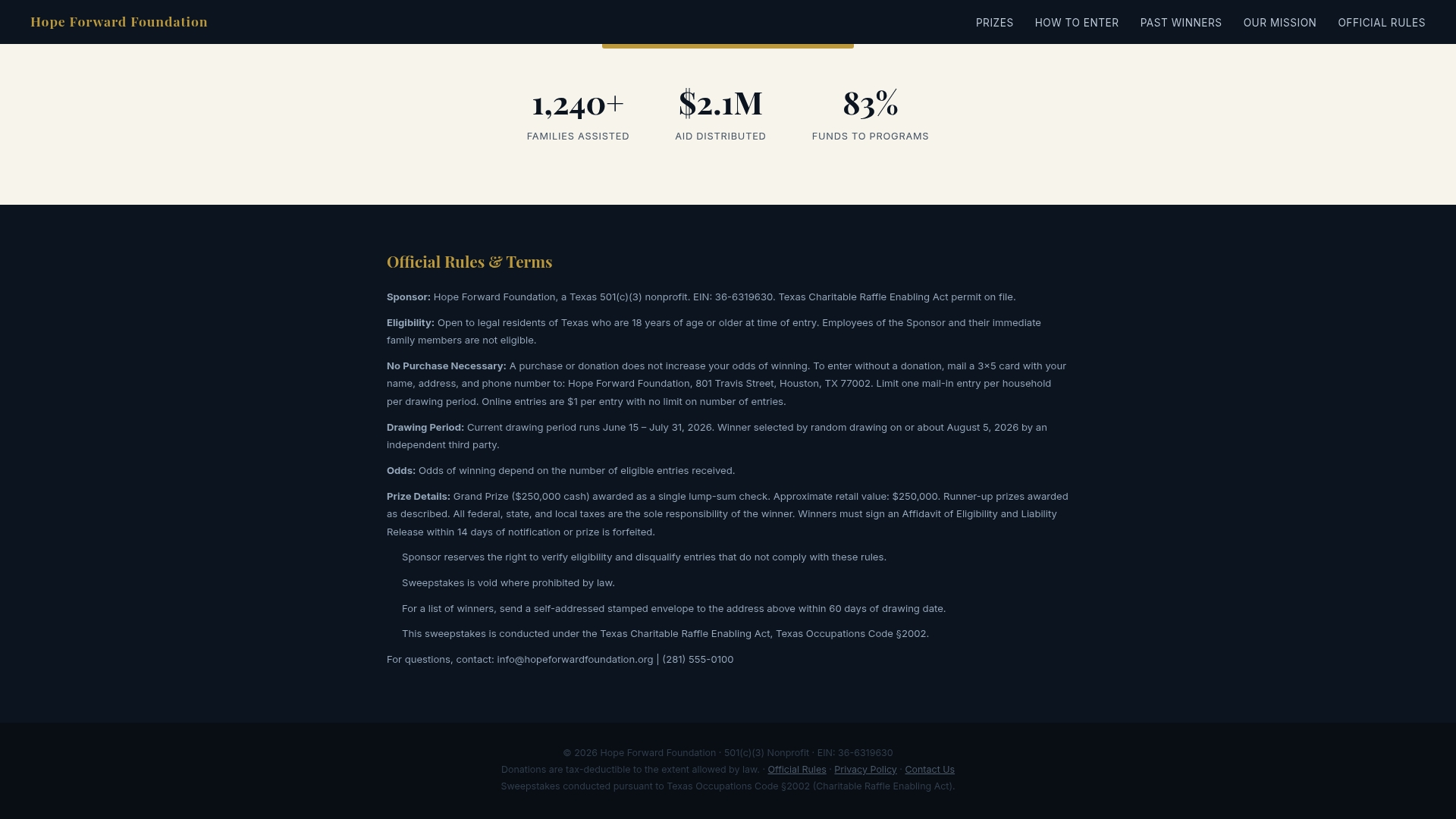
Hopeforwardfoundation is a Texas-based nonprofit that provides emergency housing assistance to families facing homelessness. Every entry in their sweepstakes directly funds that mission. The foundation directs 83% of all funds raised to housing assistance programs, so your participation creates real, measurable impact for families at risk of losing their homes.
The grand prize is $250,000 in cash. Entry is open to everyone, with a free entry option available alongside donation-based entries. You can enter the sweepstakes and review the full official rules on the Hopeforwardfoundation website. Supporting a family's housing stability and competing for a life-changing prize are not mutually exclusive. With Hopeforwardfoundation, they go hand in hand.
FAQ
What makes a charitable sweepstakes legit?
A legitimate sweepstakes offers a clearly stated free entry option, publishes full official rules, and is run by a verified 501(c)(3) nonprofit. Confirm the organization's tax-exempt status on the IRS Tax Exempt Organization Search tool before donating.
How do charity raffles work differently from sweepstakes?
Charity raffles require ticket purchases to enter, which can trigger state gambling laws and licensing requirements. Sweepstakes avoid that by offering free entry alongside donation-based entries, making them legally compliant in most U.S. states without special permits.
Are donations to charitable sweepstakes tax deductible?
Donations to qualified 501(c)(3) nonprofits are generally tax deductible. Nonprofits like the Innocence Project provide immediate email receipts for this purpose, so keep that documentation for your records.
Do I have to pay taxes if I win a sweepstakes prize?
Yes. The IRS requires you to report any prize valued over $600 as taxable income. The nonprofit will issue a 1099 form, and you are responsible for paying federal and applicable state taxes on the full prize value.
Can anyone enter a charity sweepstakes for free?
Yes. By law, charitable sweepstakes must provide a no-purchase entry method with equal odds to paid entries. That free entry path is typically an online form or a mail-in request, and it carries the same chance of winning as a donation-based entry.